zum Hauptinhalt
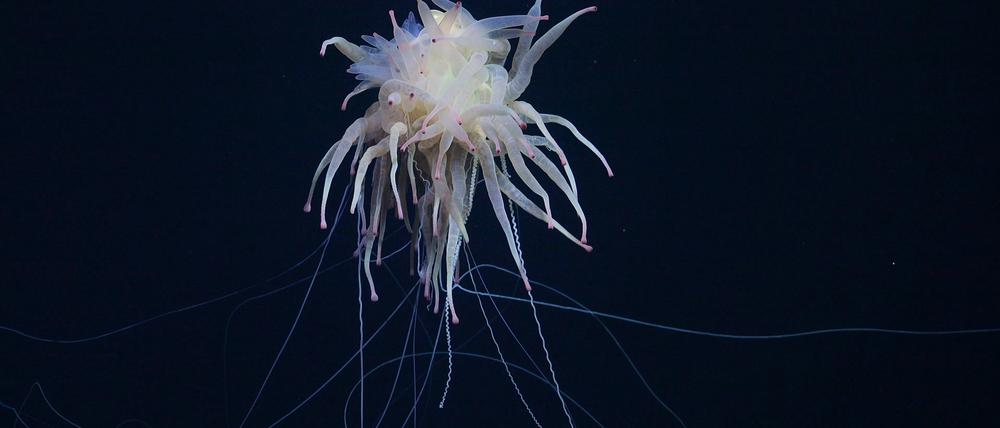
Kreatur der Tiefe: eine Bathyphysa-Staatsqualle, auch fliegendes Spaghetti-Monster genannt.

© dpa

Fliegende Spaghetti-Monster und Gespenster-Krake: Tiefsee-Oase mit neuen Arten entdeckt

Riesige Gebirgszüge durchziehen die Ozeane – Heimstätten für bizarre Unterwasserwesen. Einem Forscherteam sind nun Aufnahmen bislang unbekannter Arten gelungen.

Stand:

Das Meer erscheint eben, tatsächlich aber ragen unter der Oberfläche gewaltige Gebirgszüge steil auf. Hier sammeln sich oft Nährstoffe, sodass sich in den Ozeanen Oasen bilden, Heimstatt für mitunter bizarre Kreaturen. Die Welt der Tiefsee ist noch wenig erforscht und bietet immer wieder Überraschungen.

So auch, als ein Team von Ozeanografen einen Gebirgszug im Pazifik südlich von Chile erkundete. Sie entdeckten einen zuvor nicht bekannten Berg, der mit rund 3100 Metern höher ist als die Zugspitze. Mit einem Unterwasser-Roboter stießen sie zudem auf ein reiches Ökosystem, mit möglicherweise 20 vormals unbekannten Arten.
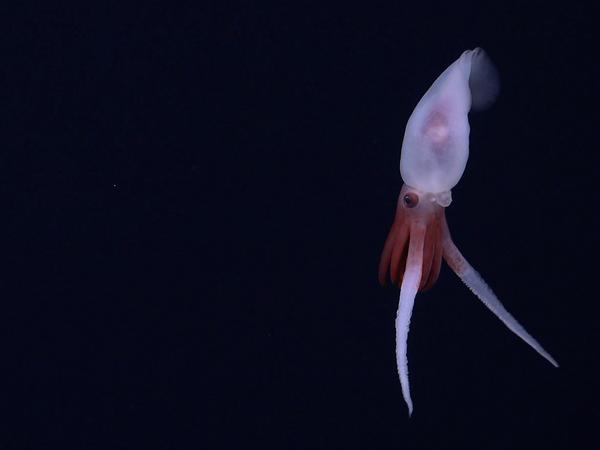
This is the first footage of a live Promachoteuthis squid. Until now, the squid genus has only been characterized from dead samples found in nets. The squid was documented on Dive 693, while exploring an unnamed seamount (internally designated as T06) along the Nazca Ridge, off the coast of Chile. Credit: ROV SuBastian / Schmidt Ocean Institute Due to our legal status as a 501(c)(3) private operating foundation, no media produced by Schmidt Ocean Institute may be used in attempting to influence legislation or lobbying. Additionally, all visual assets (Images, videos, etc) can only be used as stated by creative commons Attribution-NonCommercial-ShareAlike CC BY-NC-SA Attribution — You must give appropriate credit, provide a link to the license, and indicate if changes were made. You may do so in any reasonable manner, but not in any way that suggests the licensor endorses you or your use. NonCommercial — You may not use the material for commercial purposes. ShareAlike — If you remix, transform, or build upon the material, you must distribute your contributions under the same license as the original. https://creativecommons.org/licenses/by-nc-sa/4.0/
Erstmals vor der Kamera: Promachoteuthis-Kalmars.

© ROV SuBastian / Schmidt Ocean Institute

So gelangen Kameraaufnahmen eines lebenden Promachoteuthis-Tintenfisches, einer Gattung, die bisher nur anhand toter Exemplare in Netzen beschrieben wurde. Sie ist so selten, dass nur drei Arten auf der Grundlage einiger weniger gesammelter Exemplare bekannt sind, von denen einige aus den späten 1800er Jahren stammen.
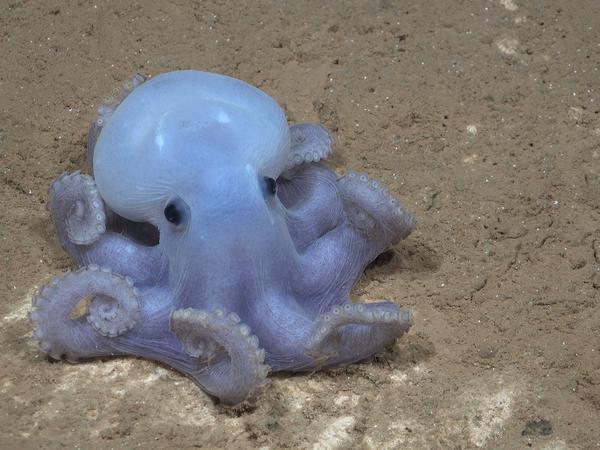
This is the first time this rare octopus species —informally named the Casper octopus — has been seen in the Southern Pacific. Discovered in 2016 and nicknamed Casper, the species has not been scientifically described or formally named, as no one has collected a specimen yet. While little is known about this species, scientists do know that it is one of two octopuses found in the Ocean’s abyssal zone. The observation in this clip took place at 4,443 meters depth, almost three miles below the Ocean’s surface.

From Dive 690, a full-depth test dive of ROV SuBastian. For this test dive, the team visited a seamount outside Peru's Exclusive Economic Zone, or EEZ. The seafloor feature had a distinctive disc shape and a summit close to ROV SuBastian's max depth of 4500m.
Credit: ROV SuBastian / Schmidt Ocean Institute

Due to our legal status as a 501(c)(3) private operating foundation, no media produced by Schmidt Ocean Institute may be used in attempting to influence legislation or lobbying.

Additionally, all visual assets (Images, videos, etc) can only be used as stated by creative commons Attribution-NonCommercial-ShareAlike
CC BY-NC-SA

Attribution — You must give appropriate credit, provide a link to the license, and indicate if changes were made. You may do so in any reasonable manner, but not in any way that suggests the licensor endorses you or your use.

NonCommercial — You may not use the material for commercial purposes.

ShareAlike — If you remix, transform, or build upon the material, you must distribute your contributions under the same license as the original.

https://creativecommons.org/licenses/by-nc-sa/4.0/
Gespenst der Meere: eine Casper-Krake.

© ROV SuBastian / Schmidt Ocean Institute

In 4443 Metern Tiefe stieß der Unterwasser-Roboter auf einen Casper-Kraken, benannt nach dem kleinen Filmgespenst. Die Art wurde noch nie gesammelt und hat daher noch keinen wissenschaftlichen Namen. Es ist das erste Mal, dass sie im südlichen Pazifik gesichtet wurde.

Chrysogorgia (golden coral) with associates (squat lobster: Uroptychus sp.; benthic ctenophore: Lyrocteis sp.; seastar: Calliaster sp.) were documented during Dive 693, while the research team explored an unnamed seamount (internally designated as T06) along the Nazca Ridge off the coast of Chile. Credit: ROV SuBastian / Schmidt Ocean Institute Due to our legal status as a 501(c)(3) private operating foundation, no media produced by Schmidt Ocean Institute may be used in attempting to influence legislation or lobbying. Additionally, all visual assets (Images, videos, etc) can only be used as stated by creative commons Attribution-NonCommercial-ShareAlike CC BY-NC-SA Attribution — You must give appropriate credit, provide a link to the license, and indicate if changes were made. You may do so in any reasonable manner, but not in any way that suggests the licensor endorses you or your use. NonCommercial — You may not use the material for commercial purposes. ShareAlike — If you remix, transform, or build upon the material, you must distribute your contributions under the same license as the original. https://creativecommons.org/licenses/by-nc-sa/4.0/
Blühenes Leben: Chrysogorgia (Goldkoralle), Springkrebs (Uroptychus), Rippenqualle (Ctenophore) und Seesterm (Calliaster).

© ROV SuBastian / Schmidt Ocean Institute

Der Roboter stieß in der Tiefe auch auf ein weißes Gebilde mit Tentakeln – es ist eine Art aus der Gruppe der Staatsquallen – Bathyphysa-Siphonophoren – die bei ihrer Entdeckung im Jahr 2015 den Spitznamen „Fliegende Spaghetti-Monster“ (siehe oben) bekam.

Die Ozeanografen unter der Leitung des kalifornischen Schmidt Ocean Institut waren mit dem Forschungsschiff Falkor auf eine 28-tägige Fahrt aufgebrochen, um einen Teil des sogenannten Chile-Rückens zu erkunden. Es handelt sich um einen Tiefsee-Gebirgszug entlang der Naht zweier auseinanderstrebender Platten der Erdkruste.

Empfohlener redaktioneller Inhalt

An dieser Stelle finden Sie einen von unseren Redakteuren ausgewählten, externen Inhalt, der den Artikel für Sie mit zusätzlichen Informationen anreichert. Sie können sich hier den externen Inhalt mit einem Klick anzeigen lassen oder wieder ausblenden.

Ich bin damit einverstanden, dass mir der externe Inhalt angezeigt wird. Damit können personenbezogene Daten an Drittplattformen übermittelt werden. Mehr Informationen dazu erhalten Sie in den Datenschutz-Einstellungen. Diese finden Sie ganz unten auf unserer Seite im Footer, sodass Sie Ihre Einstellungen jederzeit verwalten oder widerrufen können.

In rund 1500 Kilometer Entfernung von der Küste Chiles entdeckten sie dabei den zuvor unbekannten Berg. Er hat noch keinen Namen und wird vorläufig T06 benannt. Mithilfe eines Sonars kartografierten sie T06 – bislang ist nur ein Viertel der Ozeane in dieser Genauigkeit erfasst.

Grinsende Seekröte

Mit dem Unterwasser-Roboter erkundeten sie ein Areal von 800 Quadratmetern von T06 und fanden ein reiches Ökosystem aus Tiefseekorallen mit einer Vielzahl von Organismen wie Felsenfischen, Schlangensternen und Königskrabben. 
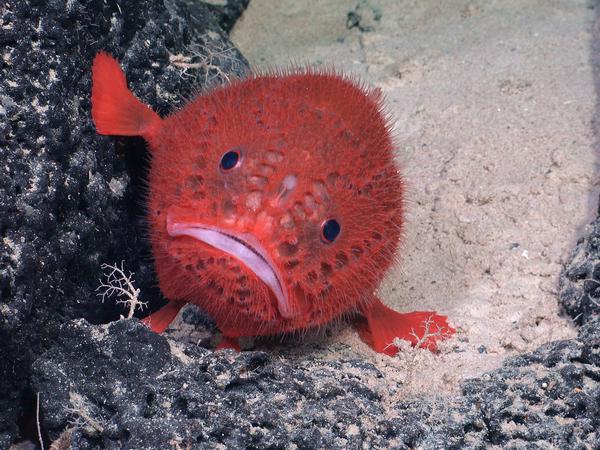
HANDOUT - 25.08.2024, ---: Eine Seekröte (Chaunacops) gehört zu den Arten, die während einer Tiefsee-Expedition an einem Unterwasser-Gebirgsrücken vor der Küste Chiles entdeckt wurden.
(zu dpa "Casper-Krake und Seekröte - Expedition erkundet Tiefsee-Gebirge") VERWENDUNG NUR IN ZUSAMMENHANG MIT DER BERICHTERSTATTUNG ZUR EXKURSION Foto: Schmidt Ocean Institute/dpa - ACHTUNG: Nur zur redaktionellen Verwendung im Zusammenhang mit der Berichterstattung über die Sendung. Das Foto darf nicht verändert und nur im vollen Ausschnitt verwendet werden. Keine Archivierung. Nur mit vollständiger Nennung des vorstehenden Credits +++ dpa-Bildfunk +++
Was denkt die wohl? Auch diese Seekröte (Chaunacops) wurde bei den Tauchfahrten entdeckt.

© dpa

Paragorgia (bubblegum coral) covered with Midas touch (Yellow Parazoanthidae), documented on seamount T08 along the Nazca Ridge off the coast of Chile. Credit: ROV SuBastian / Schmidt Ocean Institute Due to our legal status as a 501(c)(3) private operating foundation, no media produced by Schmidt Ocean Institute may be used in attempting to influence legislation or lobbying. Additionally, all visual assets (Images, videos, etc) can only be used as stated by creative commons Attribution-NonCommercial-ShareAlike CC BY-NC-SA Attribution — You must give appropriate credit, provide a link to the license, and indicate if changes were made. You may do so in any reasonable manner, but not in any way that suggests the licensor endorses you or your use. NonCommercial — You may not use the material for commercial purposes. ShareAlike — If you remix, transform, or build upon the material, you must distribute your contributions under the same license as the original. https://creativecommons.org/licenses/by-nc-sa/4.0/
Eine Kaugummi-Koralle (Paragorgia), bedeckt von einer Gelben Krustenanemone.

© ROV SuBastian / Schmidt Ocean Institute

Auch Bilder skurril aussehender Seekröten (Chaunacops) entstanden dort. An den Seebergen des südöstlichen Pazifiks gebe es eine bemerkenswerte Vielfalt von Arten, die bisher nirgendwo sonst gefunden worden seien, hieß es zu den Entdeckungen.

Vielfältiges Leben
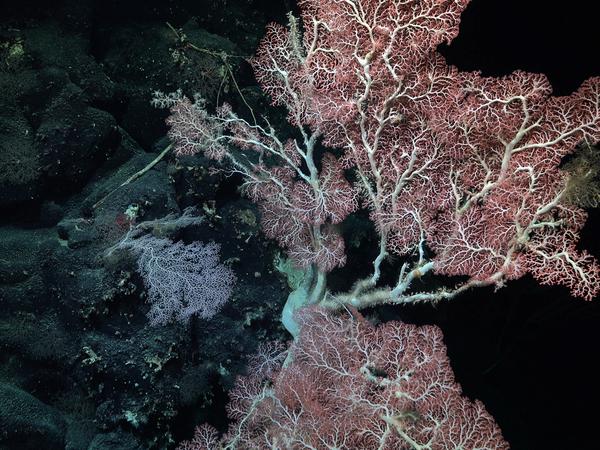
This hard coral (thought to be Corallium) was documented at 1526 meters deep on Dive 698 while researchers explored an unnamed, unexplored seamount (designated internally as T09) along the Nazca Ridge off the coast of Chile. Credit: ROV SuBastian / Schmidt Ocean Institute Due to our legal status as a 501(c)(3) private operating foundation, no media produced by Schmidt Ocean Institute may be used in attempting to influence legislation or lobbying. Additionally, all visual assets (Images, videos, etc) can only be used as stated by creative commons Attribution-NonCommercial-ShareAlike CC BY-NC-SA Attribution — You must give appropriate credit, provide a link to the license, and indicate if changes were made. You may do so in any reasonable manner, but not in any way that suggests the licensor endorses you or your use. NonCommercial — You may not use the material for commercial purposes. ShareAlike — If you remix, transform, or build upon the material, you must distribute your contributions under the same license as the original. https://creativecommons.org/licenses/by-nc-sa/4.0/
Diese Hartkoralle (vermutlich Corallium) wurde in 1526 Metern Tiefe am noch namenlosen Berg T09 gefilmt.

© ROV SuBastian / Schmidt Ocean Institute
A sea urchin in the genus Argopatagus - and thought to be a new species - was documented on Dive 695, exploring an unnamed ridge (internally designated Dragon's Back) along the Nazca Ridge off the coast of Chile. Credit: ROV SuBastian / Schmidt Ocean Institute Due to our legal status as a 501(c)(3) private operating foundation, no media produced by Schmidt Ocean Institute may be used in attempting to influence legislation or lobbying. Additionally, all visual assets (Images, videos, etc) can only be used as stated by creative commons Attribution-NonCommercial-ShareAlike CC BY-NC-SA Attribution — You must give appropriate credit, provide a link to the license, and indicate if changes were made. You may do so in any reasonable manner, but not in any way that suggests the licensor endorses you or your use. NonCommercial — You may not use the material for commercial purposes. ShareAlike — If you remix, transform, or build upon the material, you must distribute your contributions under the same license as the original. https://creativecommons.org/licenses/by-nc-sa/4.0/
Eine Seegurke der Gattung Argopatagus, vermutlich eine noch unbekannte Art.

© ROV SuBastian / Schmidt Ocean Institute

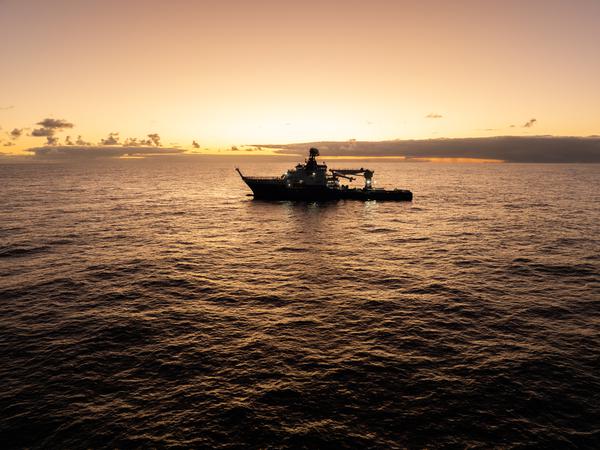
Oceanographic Research Vessel Falkor (too) in the South Pacific, sailing above the Nazca Ridge, an underwater seamount chain off the coast of Chile. Credit: Misha Vallejo Prut / Schmidt Ocean Institute Due to our legal status as a 501(c)(3) private operating foundation, no media produced by Schmidt Ocean Institute may be used in attempting to influence legislation or lobbying. Additionally, all visual assets (Images, videos, etc) can only be used as stated by creative commons Attribution-NonCommercial-ShareAlike CC BY-NC-SA Attribution — You must give appropriate credit, provide a link to the license, and indicate if changes were made. You may do so in any reasonable manner, but not in any way that suggests the licensor endorses you or your use. NonCommercial — You may not use the material for commercial purposes. ShareAlike — If you remix, transform, or build upon the material, you must distribute your contributions under the same license as the original. https://creativecommons.org/licenses/by-nc-sa/4.0/
Das Vorschungsschiff Falkor (too) im Südpazifik über dem Nazca-Untersee-Gebirge.

© Misha Vallejo Prut / Schmidt Ocean Institute

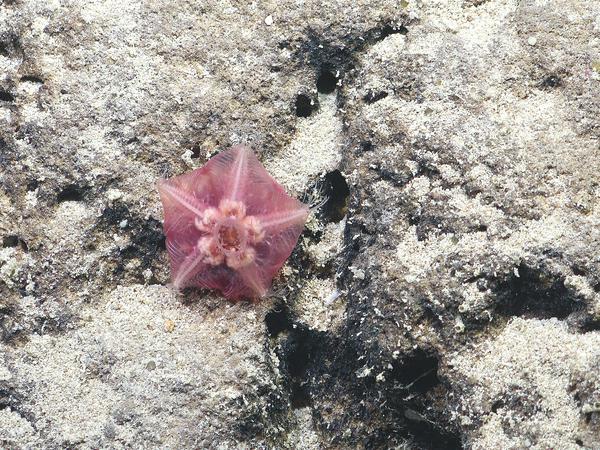
A deep-sea starfish in the genus Hymenaster - thought to be a newly discovered species - is documented on Dive 691 at Shorygin Guyot in The Nazca Ridge, off the coast of Chile. Credit: ROV SuBastian / Schmidt Ocean Institute Due to our legal status as a 501(c)(3) private operating foundation, no media produced by Schmidt Ocean Institute may be used in attempting to influence legislation or lobbying. Additionally, all visual assets (Images, videos, etc) can only be used as stated by creative commons Attribution-NonCommercial-ShareAlike CC BY-NC-SA Attribution — You must give appropriate credit, provide a link to the license, and indicate if changes were made. You may do so in any reasonable manner, but not in any way that suggests the licensor endorses you or your use. NonCommercial — You may not use the material for commercial purposes. ShareAlike — If you remix, transform, or build upon the material, you must distribute your contributions under the same license as the original. https://creativecommons.org/licenses/by-nc-sa/4.0/
Auch dieser Seestern der Gattung Hymenaster ist vermutlich eine neue Art.

© ROV SuBastian / Schmidt Ocean Institute

Vor den Expeditionen des Schmidt Ocean Institute in diesem Jahr waren 1.019 Arten in diesem Teil des Pazifiks bekannt. Inzwischen sind es mehr als 1.300, Tendenz steigend. Die Aufzeichnungen werden an „Ocean Census“ weitergeleitet, eine internationale Allianz, um die Entdeckung und den Schutz des Lebens im Meer zu beschleunigen.

„Die Seeberge des Südostpazifiks beherbergen eine bemerkenswerte biologische Vielfalt mit Arten, die bisher nirgendwo sonst gefunden wurden“, sagte Alex David Rogers, wissenschaftlicher Direktor von Ocean Census. Schon bei zwei vorangegangenen Expeditionen im Januar und Februar hatte das Team 150 bisher unbekannte Arten katalogisiert und 25 Untersee-Berge kartografiert.

Zur Startseite

showPaywall:
false
isSubscriber:
false
isPaid:
console.debug({ userId: "", verifiedBot: "false", botCategory: "" })